
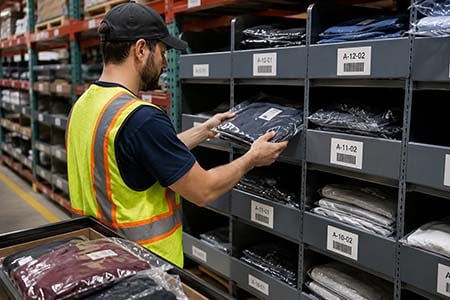
 Warehouse throughput problems occur when the operation cannot consistently process and ship the required workload within the available operating day. Picking is often where the problem becomes visible, but the actual constraint may originate in receiving, putaway, replenishment, inventory availability, layout, systems, packing, shipping or returns. The first step is to identify the root cause before adding labor, space, equipment or automation.
Warehouse throughput problems occur when the operation cannot consistently process and ship the required workload within the available operating day. Picking is often where the problem becomes visible, but the actual constraint may originate in receiving, putaway, replenishment, inventory availability, layout, systems, packing, shipping or returns. The first step is to identify the root cause before adding labor, space, equipment or automation.
When throughput begins to break down, the symptoms are usually easy to see. Orders carry over into the next day, shipping cutoffs are missed, overtime increases, and employees seem constantly busy even though the warehouse continues to fall behind.
The mistake is assuming that the most visible problem is necessarily the real problem.
Because picking is one of the most labor-intensive warehouse functions, management often focuses there first. If orders are not being completed, it is easy to conclude that the pickers are too slow or that more people are needed. Sometimes that is true. Just as often, pickers are reacting to problems created somewhere else in the operation.
A picker waiting for inventory may really be experiencing a replenishment problem. The replenishment problem may exist because the forward pick locations are too small.
Those locations may be too small because the min/max quantities have not been reviewed in years. Or the inventory may not even be available for replenishment because receiving and putaway are behind.
The goal of warehouse throughput improvement is not simply to make people work faster. It is to understand how work moves through the entire facility, identify where that flow is breaking down, and correct the causes in the right sequence.
What Does Warehouse Throughput Really Mean?
Warehouse throughput is the amount of work an operation can successfully process through its entire workflow during a defined period.
For an order fulfillment operation, the real finish line is not whether all of the orders were picked. It is whether the required orders were processed accurately and shipped within the required operating day.
That distinction matters because every major warehouse process depends on the ones around it. Inventory has to be received, put away, made available for replenishment, picked, packed, manifested, staged and shipped. Returns create an additional reverse flow that also consumes labor, space and inventory-handling capacity.
A problem anywhere along that chain can reduce total throughput.
That is why warehouse performance should be evaluated as an operating system rather than as a collection of independent departments.
Start With the Symptom, Then Find the Cause
Daily order carryover is one of the clearest signs that a warehouse has a throughput problem.
If orders that should have shipped today are still sitting in the operation tomorrow morning, something prevented the warehouse from processing the required workload.
The first question should not be, “How do we make the pickers go faster?”
It should be, “What prevented us from completing today’s workload today?”
The answer may involve labor, but it may also involve delayed receiving, slow putaway, inaccurate inventory, replenishments that were not completed, poor slotting, excessive travel, congestion, inefficient picking methods, cumbersome system transactions, packing bottlenecks, staging problems or weak management controls.
Most struggling operations have more than one issue.
The objective is to separate the symptoms from the causes before deciding what to fix.
Understand How the Process Is Supposed to Work
A good throughput assessment begins with management and supervisors explaining how the operation is intended to function.
Walk through the process from beginning to end. Understand how receipts are scheduled and processed, how inventory is put away, how replenishments are generated, how orders are released, how employees are assigned work, what happens when an item cannot be found, how completed picks move to packing, how shipments are manifested and staged, and how returns are processed.
This gives you the intended process.
It does not tell you what is actually happening.
That requires observation.
Compare the Intended Process With the Actual Process
Once the process has been explained, go to the floor and follow the people doing the work.
Shadow receivers, putaway operators, replenishment employees, pickers, packers and returns processors. Watch how they actually perform their jobs and compare that with the process management described.
This is where many warehouse problems begin to reveal themselves.
Employees who perform the work every day usually know where they lose time. They may not always understand why a problem exists, but they know when they are repeatedly waiting, searching, walking farther than necessary, fighting with a system, looking for supplies or working around a process that does not function well.
When an employee deviates from the intended process, ask why.
Sometimes the answer points to training or accountability. Other times the employee has developed a workaround because the official process is inefficient or simply does not work.
You cannot determine that from a conference room.
You have to observe the work.
Receiving Can Create a Throughput Problem Long Before Picking Begins
A warehouse cannot make inventory available for orders until it has been physically received and entered into usable stock.
When receiving becomes congested, the effects can travel through the entire operation.
The receiving dock may not have enough space for the volume arriving. Trailers, containers, pallets or cartons may accumulate faster than employees can unload and process them. Inbound inventory may sit on the dock waiting for paperwork, system transactions or available putaway locations.
This creates more than a receiving problem.
If just-in-time receipts, reorders or late vendor shipments are not processed quickly enough, the inventory may not become available when picking needs it. By the time the shortage becomes visible on the picking floor, the actual constraint may have started hours earlier at receiving.
Look at how quickly receipts move through the process. Are trailers waiting unnecessarily? Are pallets sitting on the dock? Is the receiving area constantly congested? Is inbound volume arriving faster than the operation can absorb it?
The warehouse may have enough inventory physically inside the building and still be unable to use it.
Putaway Is Part of Throughput, Not an Administrative Afterthought
Receiving inventory does not help fulfillment if that inventory cannot be put away and made available.
If putaway locations are insufficient or the putaway process cannot keep pace, product begins accumulating on the receiving dock. That inventory then occupies space needed for additional inbound receipts, causing receiving to slow even further.
The cycle can quickly become self-reinforcing.
Insufficient putaway capacity causes inventory to sit on the dock. Receiving becomes congested. Inbound processing slows. Inventory availability declines. Replenishments cannot be completed, and pickers eventually arrive at empty locations.
This is why dock-to-stock time can be such an important metric.
Inventory sitting on the receiving dock is not the same as inventory available for an order.
Replenishment Problems Often Appear to Be Picking Problems
One of the most common throughput issues occurs when a picker reaches a forward pick location and the required inventory is not there.
It is easy to blame picking because that is where the delay becomes visible.
The real issue may be replenishment.
Start by determining whether replenishments are being cleared every day and whether they are completed before they interfere with picking. If they are not, determine why.
Then look at the pick locations themselves.
Are the minimum and maximum quantities still appropriate for current demand? When were those levels last reviewed? Are high-demand SKUs sitting in locations that are physically too small? Is the operation repeatedly replenishing the same fast-moving items throughout the day?
Where the data is available, FCBCO looks at the average days of supply held in the forward pick location based on current and peak demand.
For significant demand drivers, a location that holds only a fraction of a day’s demand can create constant replenishment activity and frequent stockouts. Depending on the SKU and operation, increasing the forward pick quantity to hold roughly three to five days of peak demand can sometimes reduce replenishment frequency and improve availability.
That is not a universal rule. The correct quantity depends on cube, storage media, SKU velocity, inventory investment, handling characteristics and available space.
The important point is that pick-location sizing should be intentional. It should balance space utilization, replenishment workload and picking productivity.
Slotting Can Have a Major Effect on Warehouse Throughput
Walking is one of the largest hidden consumers of warehouse labor.
If high-demand SKUs are positioned poorly, employees may spend a significant portion of their shift traveling rather than picking.
That is why slotting should be based on actual demand rather than intuition or historical placement.
Management should know which SKUs generate the most picking activity and whether those items are positioned accordingly. Fast-moving products should generally receive favorable locations, and high-demand items should be placed within an appropriate picking or “golden” zone whenever practical.
If top demand drivers are scattered throughout the building, excessive travel becomes built into the process.
One of the first questions should therefore be whether the company even has reliable reporting that identifies its highest-demand items.
If management cannot identify the products generating the most work, effective slotting becomes very difficult.
Congestion Can Make More Labor Less Productive
Adding employees does not automatically increase warehouse throughput.
In a congested facility, additional labor can make the problem worse.
Narrow aisles, crossing travel paths, poor staging locations, equipment conflicts and replenishment occurring during peak picking periods can all cause employees to interfere with one another.
A warehouse may appear understaffed because orders are falling behind. Management adds more pickers, but the additional people are simply added to already congested aisles.
Throughput barely improves.
The problem was not the number of employees. It was flow.
Warehouse throughput should therefore be evaluated by looking at how inventory, people, equipment and orders move through the building together.
Make Sure the Picking Method Matches the Order Profile
Picking deserves close attention because it is frequently one of the lst warehouse labor expenses.
But productivity problems are not always caused by the employee.
The picking method itself may be inefficient for the order profile.
An operation may use discrete order picking, where one employee completes one order at a time, even though the volume, SKU commonality and order characteristics may support batch picking, cluster picking, zone picking, wave picking or another picking method.
The correct approach depends on the actual workload. Orders per day, lines per order, units per line, SKU velocity, product characteristics, service requirements, layout, available equipment and WMS capabilities all matter.
The objective is not to introduce a more sophisticated picking method because it sounds better.
The objective is to determine whether the current method is the most efficient way to process the actual demand.
Systems Can Create Inefficiency, but They Are Not Always the Root Cause
Warehouse systems can absolutely reduce throughput.
Paper-based picking may limit speed or accuracy. A WMS may require too many screens, confirmations or repetitive transactions. Poor reporting may make it difficult to identify replenishment problems, demand drivers or slotting opportunities.
Those issues should be investigated.
But replacing the system should not automatically become the answer.
Some companies cannot justify a major WMS replacement. Others simply do not need one.
In many cases, meaningful improvements can come from simplifying workflows, improving system configuration, eliminating unnecessary steps, building better reporting or making better operational decisions with the data already available.
Technology should be changed when it is truly creating the constraint.
It should not become a convenient explanation for poor operating fundamentals.
Picking the Orders Does Not Mean the Throughput Problem Is Solved
Improving picking is valuable, but picking is not the end of the fulfillment process.
A warehouse can pick every required order and still fail to ship the workload on time.
If picking produces 1,000 completed orders but packing can only process 800, the warehouse still has a throughput problem. The constraint has simply moved downstream.
This is one of the most important concepts in warehouse improvement.
Do not optimize one department without understanding what the next process can absorb.
Packing Can Become the Next Bottleneck
Packing should be observed in exactly the same way as picking.
Watch how employees perform the work and look for interruptions.
Do packers have the supplies they need at the workstation, or are they repeatedly leaving to retrieve cartons, tape, labels or void fill?
Are there too many carton sizes, causing employees to spend time deciding which box to use?
Are workstations designed efficiently?
Once an order is packed, can the carton move away from the workstation immediately, or do finished orders begin accumulating?
Some operations rely on pallets or carts to move completed cartons away from packing. If those pallets or carts repeatedly fill up and employees have to stop packing to clear space, the packing problem may actually be a takeaway or staging problem.
In other operations, the constraint may occur during manifesting, labeling or carrier sorting.
The same diagnostic principle applies: observe the work, identify where time is being lost, determine why it is happening and classify the root cause.
Shipping and Manifesting Have to Complete the Flow
Packed orders still have to leave the building.
Manifesting, carrier sorting, staging, pallet building, loading, dock availability, trailer capacity and carrier cutoffs can all create constraints.
If an order is packed but still sitting on the floor or on a pallet when the shipping window closes, the order has not completed the fulfillment process.
The key throughput question remains the same:
Did the required orders ship today?
That is a better system-level measure than simply asking whether each department hit its own productivity target.
Returns Create Another Throughput Stream
Rturns are often treated as secondary work, but in ecommerce and retail operations they can consume significant labor, space and inventory-handling capacity.
A poorly designed returns process can also interfere with normal warehouse flow.
Start with the processing area itself. Is there enough space for the volume? Are unopened returns accumulating? Are employees spending excessive time looking up orders or researching the disposition of returned items?
Trash and recycling can become a surprisingly important constraint. If cartons, packing materials and damaged product are not removed quickly, the returns area can become congested even when staffing levels are adequate.
Return putaway also differs from traditional receiving.
Receiving often involves pallets or cases containing multiple units of the same SKU. Returns may produce one unit of SKU A, another of SKU B, another of SKU C and another of SKU D.
Sending an employee around the warehouse putting away isolated units can create a tremendous amount of travel.
Alternative processes may improve efficiency. Returns can sometimes be grouped by aisle or zone before putaway. In other operations, a temporary or dynamic returns location may allow returned inventory to become available quickly and be consumed first in upcoming pick batches.
The right method depends on the WMS, SKU characteristics, order profile, layout and flow, but the goal remains the same: return usable inventory to stock with as little unnecessary handling and travel as possible.
Separate Fact From Fiction Before Assigning Blame
Throughput problems often create finger-pointing.
Picking blames replenishment. Replenishment blames receiving. Receiving blames putaway. Employees blame the WMS. Management blames employees. Packing blames picking.
Most people are describing the problem from the part of the operation they see every day.
The job of the assessment is to hear those explanations, observe the processes, review the data and objectively separate fact from fiction.
That means investigating each process independently before connecting the problems.
Is an employee poorly trained, or has the employee developed a workaround because the official process does not work?
Is a picker skipping items because of weak accountability, or are inventory-location errors genuinely making products difficult to find?
Is replenishment underperforming because employees are too slow, or because forward pick locations are undersized and creating an impossible amount of replenishment work?
Only after those questions are answered can problems be correctly categorized as people, process, system, inventory, replenishment, slotting, layout, capacity or management issues.
Most operations will have problems in several categories.
Throughput Problems Often Form a Chain of Causes
Warehouse problems rarely occur in isolation.
Suppose the min/max quantities in the pick locations have not been updated as demand changed.
The pick faces no longer hold enough inventory.
That creates excessive replenishments.
The replenishment team falls behind.
Pickers begin reaching empty locations.
Orders are shorted or delayed.
Incomplete orders require additional handling.
Packing cannot complete those orders.
Customer shipments carry over into the next day.
What originally appeared to be poor picking productivity may actually have begun with poor pick-face sizing and weak replenishment management.
The same thing can happen upstream.
If receiving space is inadequate, inventory accumulates on the dock. Putaway falls behind. Inventory needed for current orders remains unavailable. Replenishment cannot access the product. Pick locations stock out, and picking falls behind.
By the time the problem becomes visible, the root cause may be several steps removed from the symptom.
That is why warehouse throughput needs to be analyzed as a connected system.
Warehouse Performance Usually Erodes Over Time
Many warehouses do not suddenly become inefficient.
They gradually lose operating discipline.
Min/max quantities stop being reviewed. Demand patterns change, but slotting does not. Replenishments begin carrying over. Cycle count variances increase. Employees develop workarounds. Supervisors become accustomed to exceptions. Reports stop being reviewed. Putaway locations become disorganized. Packing areas become cluttered.
Individually, none of these issues may seem serious enough to create a crisis.
Together, they can eventually make the operation unsustainable.
What appears to management as a sudden throughput problem may actually represent months or years of operational erosion.
Sustainable improvement therefore requires more than fixing today's most visible bottleneck. It often means restoring basic operating disciplines that have gradually been lost.
Categorize the Problems Before Selecting Solutions
Once the issues have been verified, classify them before deciding what to do.
Typical root-cause categories include:
| Root-Cause Category | Typical Issues |
|---|---|
| People and Culture | Training, accountability, work standards, supervision, trust |
| Process | Picking methods, unnecessary touches, poor sequencing, inefficient returns handling |
| Inventory and Replenishment | Stockouts, poor min/max settings, inventory inaccuracies, undersized pick faces |
| Systems | Excessive transactions, cumbersome workflows, weak reporting |
| Slotting | Fast movers poorly positioned, excessive travel |
| Layout and Design | Congestion, inadequate docks, poor staging, inefficient workstation design |
| Capacity | Insufficient storage, putaway, packing, staging or dock capacity |
| Management and Measurement | Missing KPIs, weak reporting, inconsistent follow-through |
Categorizing the problems prevents an operation from treating every issue with the same solution.
It also makes prioritization much easier.
Prioritize Improvements Before Trying to Fix Everything
A warehouse assessment may identify dozens of opportunities.
Trying to implement all of them at once is rarely practical.
Each improvement should be evaluated based on the investment required, how long it will take, whether additional labor is needed, the expected benefit and whether prerequisite work has to occur first.
Start with the opportunities that can create meaningful improvement quickly with little or no capital and without additional headcount.
These low-hanging improvements can have an organizational benefit as well as an operational one.
In companies where employees have lived with recurring problems for a long time, visible improvements show that management is actually addressing the issues that make their jobs harder.
Communicate what is changing, why it is changing, how the new process should work and what benefit employees should expect.
Then sequence the larger process, technology, layout or capital improvements logically.
Measure Whether Warehouse Throughput Is Actually Improving
A change is not an improvement simply because it was implemented.
The operation needs metrics that show whether performance is moving in the right direction.
The exact measures will vary, but the important principle is to monitor the entire process rather than one department.
Receiving and Putaway
Useful measures may include dock-to-stock time, receipts processed per man-hour, aging of unprocessed receipts and the size of the putaway backlog.
If receiving and putaway are improving, inventory should become available more quickly.
Replenishment
Track whether replenishments are being completed each day and whether open or aged replenishments are declining.
For important demand drivers, monitor the days of supply held in the forward pick location and identify locations that repeatedly stock out or require excessive replenishment.
Picking
Depending on the available data, useful measures may include picks per man-hour, lines per man-hour, units per man-hour, orders per man-hour and average pick time.
Order carryover and picking accuracy should also be monitored.
Higher productivity does not represent improvement if accuracy deteriorates.
Packing
Track orders, lines or units packed per man-hour, average packing time and the backlog waiting for packing.
This helps determine whether improvements to picking are actually increasing total throughput or simply pushing the constraint downstream.
Shipping
Monitor whether shipments are manifested on time, reach staging, meet carrier cutoffs and physically leave the warehouse within the required operating day.
Ultimately, throughput needs to translate into completed shipments.
Inventory Control
If inventory accuracy is contributing to picking and replenishment problems, monitor cycle count productivity and inventory variances.
The goal is not only to count faster. Variances should decline over time as the underlying inventory problems are corrected.
Returns
Useful measures can include units returned per man-hour, return backlog, aging of unprocessed returns, disposition time and the amount of time required before sellable returned inventory becomes available again.
These metrics help determine whether the reverse-logistics process is supporting or interfering with the rest of the warehouse.
Make Sure You Fixed the Constraint Instead of Moving It
After implementing an improvement, continue watching the entire operation.
If picking productivity increases by 20%, did shipments also increase? Or did the additional output create a larger packing backlog?
If receiving improves, did dock-to-stock time improve as well, or did inventory simply accumulate in putaway?
If packing improves, can manifesting, staging and shipping absorb the additional volume?
True warehouse throughput improvement occurs when overall system performance improves.
Local productivity improvement is useful only if the rest of the operation can support it.
The constraint will also move as an operation improves. Once one bottleneck is removed, another process may become the limiting factor.
That is normal.
The objective is to keep following the flow.
When Is a Broader Warehouse Operational Assessment Needed?
Some throughput problems are obvious enough that management can address them directly.
Others are more difficult because symptoms appear in multiple departments, explanations conflict, or the company does not have enough reliable data to identify the actual cause.
A broader warehouse operational assessment may be appropriate when order carryover persists, service levels are declining, labor continues to increase without equivalent output, inventory availability repeatedly disrupts orders, congestion has become normal, or management is considering significant investments in labor, space, systems or automation without being confident that those investments address the real constraint.
The purpose of the assessment should not be to produce a long list of everything that could theoretically be improved.
It should answer a much smaller set of important questions.
What is preventing the warehouse from meeting its required workload?
Where does the constraint actually originate?
Which issues are symptoms and which are root causes?
Which improvements can be made quickly?
Which require capital or additional resources?
What needs to happen first?
And how will management prove that throughput actually improved?
The end result should be a prioritized and measurable operating improvement plan.
The Bottom Line
Warehouse throughput is not simply a picking problem.
It is the result of how effectively the entire operation moves inventory and orders through receiving, putaway, replenishment, picking, packing, manifesting and shipping while also controlling the reverse flow created by returns.
Picking is often where the problem becomes most visible because so much labor and customer service depend on it. But optimizing picking alone will not solve a constraint that begins in receiving, inventory availability, replenishment, packing, shipping, systems, layout or operating discipline.
The goal is to identify the real constraint, improve the highest-value problems in the right sequence, measure the results and put enough management discipline in place to prevent the operation from gradually sliding backward again.
That is what sustainable warehouse throughput improvement looks like.
Need Help Identifying What Is Limiting Your Warehouse?
When the source of a throughput problem is unclear, an independent warehouse assessment can help separate symptoms from root causes and prioritize improvements based on impact, cost, timing and implementation requirements.
FCBCO evaluates the operation from receiving through shipping to determine where flow is breaking down, what is causing the problem and what should be corrected first.
Talk with FCBCO about a warehouse assessment.



SHARE